
The Story Behind Our Traditional Greek Fish Soup (Psarosoupa)| PJ Kabos Mediterranean Traditions
Updated: 2 hours ago
Discover the history, traditions and Mediterranean flavors behind PJ Kabos' psarosoupa — Greece’s traditional fish soup made with fresh fish, vegetables, lemon and generous amounts of olive oil.
PJ Kabos celebrates the foods, ingredients and culinary heritage of the Mediterranean — where extra virgin olive oil, simple ingredients, shared meals and time-honored traditions remain at the heart of everyday life.
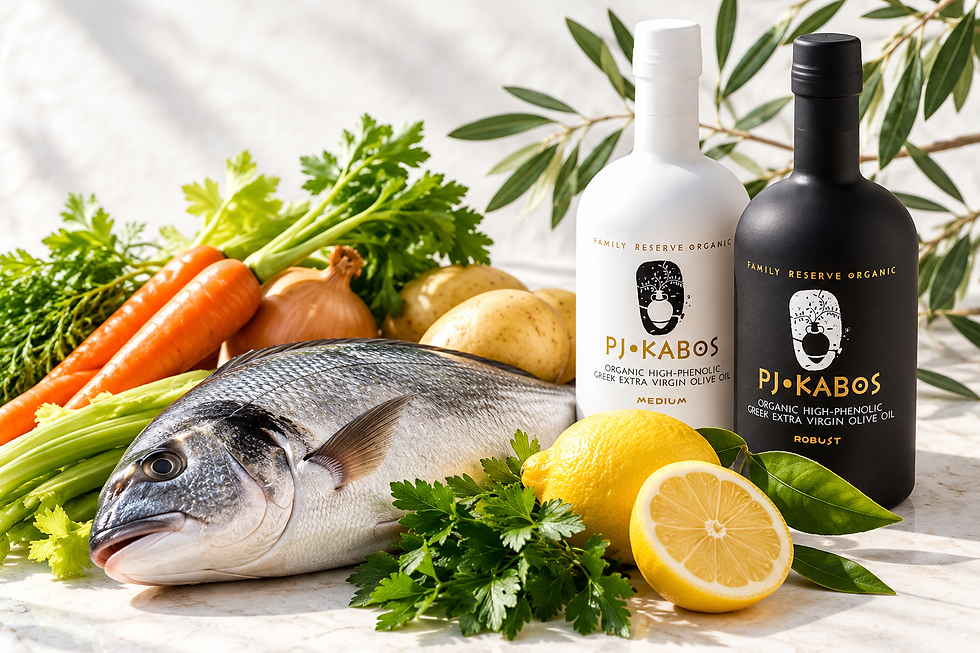
When I first came to Greece, I was amazed at how much I loved the simple fish soup I was introduced to by my mother-in-law. She simply called it “fish soup” — or, as she said in Greek, psarosoupa. Psári means fish and soupa means soup. Nothing more. Just “psarosoupa,” she would say as she generously drizzled olive oil over the whole fish waiting to be cooked in her big old cooking pot.
The Fish Soups I Knew
I had, of course, enjoyed various classic American fish soups while growing up in different parts of the United States. There were homemade Southern gumbos prepared by a talented home cook from Louisiana’s Creole country who lived near my family in Florida; thick and hearty New England clam chowders during visits to my grandmother in Maine; She-Crab Soup in the charming, sometimes rather shabby seafood shacks scattered along the beautiful coasts of Virginia and the Carolinas; and salmon chowder in the fishing towns of the Pacific Northwest.
I loved them all. But the fish in those soups had always arrived neatly chopped into lovely chunks, mingling with potatoes, onions, carrots, celery, peppers or other seafood. Often, the fish was surrounded by a creamy broth or tomato base or, in the case of gumbo, a flavorful roux. I hardly realized I was eating fish! After all, as a child, my everyday fish experience was mostly limited to fish sticks — or “fish fingers,” as they’re called in Europe — tuna and smoked herring from a can.
An “All-In” Fish Dish
But my mother-in-law’s hearty Greek psarosoupa was something entirely different. It was a true “all-in” fish experience: head, skin, tail and bones all simmering together in a pot with potatoes, carrots, celery and a generous — very generous! — amount of olive oil.
Let me tell you, olive oil doesn’t cover much! It was eye-opening to see a whole fish cooked in such a simple, straightforward way. This was completely new territory for me.
In hindsight, it seems rather strange that I had never seen a whole fish simmering in a pot before, let alone watched someone vigorously and expertly clean the scales from one in her backyard. What made the scene even more memorable was that, when in Athens, my mother-in-law lived in one of the capital’s most affluent suburbs — not in a rustic fishing village! Yet there she was, cleaning a whole fish outdoors and attracting what seemed like every cat in Greece, all sitting hopefully at her feet waiting for a morsel. In my experience, fish had always arrived already cleaned — either at the shop or by fishermen (or their wives) down at the wharf.

A Greek Fishing Village in Florida
Back in Florida, I often went with my mother to the wharf in what was then the sleepy little fishing village of Destin. Yes, the same popular destination it is today was, back in the 1970s, home to a thriving Greek fishing community.
In the evenings, when the fishermen returned with their daily catch, my mother would buy fresh grouper, red snapper and other fish from the fishermen’s wives, who cleaned, dressed and sliced the just-caught fish in the back of their shops. All Mom had to do was choose the beautifully prepared fish steaks she wanted, take them home and plop them on the grill. Talk about delicious! And only a couple of big bones to deal with.
My brother even went out into the Gulf on one of those fishing boats once and caught an enormous grouper — around 100 pounds — which our family and friends enjoyed for weeks.

But despite all that wonderful fresh fish — and all those Greek fishermen — Greek-style fish soup was never on our menu. I had to travel all the way to Greece before I finally discovered psarosoupa.
No Single Psarosoupa Recipe
Like many traditional Greek dishes, psarosoupa varies from family to family and region to region, depending on the fish available, seasonal produce and family tradition. Potatoes, carrots, onions and celery are common; some cooks add rice or make an avgolemono sauce, while the fish may be served in the soup or separately.
My mother-in-law’s version was wonderfully straightforward: whole fish, vegetables, lemon and lots of olive oil. Cooking the fish with its head, skin and bones adds flavor and richness to the broth — and she was perfectly comfortable navigating all those bones. I was not. And then there were the eyes.
I don’t mind bones in a whole baked or grilled fish, where I can see and remove them. But eyes floating around in my soup? No, thank you! All these years later, I still prefer my psarosoupa without the adventure — hence the evolution of her family recipe.
Takeaway
Whole fish traditionally gives psarosoupa a flavorful, rich broth, but Greek fish soup is not defined by one rigid recipe. Fish, vegetables, olive oil and lemon form the foundation, while preparation varies by family and region.
A Very Old Greek Tradition
Fish has been part of the Greek diet for thousands of years, and ancient Greek writers described fish prepared in many ways, including boiling. We can’t say that today’s psarosoupa is the same soup eaten in ancient Greece — there were no potatoes, after all! But fresh fish cooked simply with ingredients at hand, including that most enduring of Greek ingredients, olive oil, belongs to a very old Greek culinary tradition.
Olive Oil Is More Than a Finishing Touch
In my mother-in-law’s psarosoupa, olive oil was never an afterthought. She didn’t simply drizzle a little over the finished soup. A generous amount went directly into the pot, where it cooked together with the fish, vegetables and broth. In our PJ Kabos version, we add another drizzle of peppery, high-phenolic EVOO at serving. That is still one of the things I love most about this soup.
It is a wonderful example of something found again and again in traditional Mediterranean cooking: olive oil isn’t merely a condiment sitting on the table. It is an ingredient — and often a generous one.
Takeaway
The olive oil becomes part of the dish itself, adding richness and body to what is otherwise an extraordinarily simple combination of ingredients.
Ready to Bring It to the Table?
Would you like to try our family's version of this traditional Greek fish soup?
Our Greek Fish Soup (Psarosoupa) | PJ Kabos Recipe keeps the simple ingredients, wonderful Mediterranean flavors and generous olive oil of my mother-in-law’s original recipe — but uses cod fillets instead of a whole fish.
All the flavor, without having to worry about those fish bones (or eyes!).
Kali Orexi — Happy Eating!

Visit our Guide Library to browse all PJ Kabos Guide articles, with titles and brief descriptions to help you find the topics that interest you.
While you're here on The Fat Olive Blog, if you enjoy cooking, please check out our many
PJ Kabos Recipes (e.g., Greek Fava), or explore our Mediterranean Traditions articles (e.g., Ladera Dishes) or step into special moments of our company with PJ Kabos Journal (e.g., Nobu Matsuhisa & PJ Kabos).
You can also have a look around our websites and shop our high-phenolic extra virgin olive oils directly at PJ Kabos.com or OliveOil.com or through PJ Kabos Amazon Store. Follow along with us on Instagram for photos from our groves in Greece, olive oil production, articles, family history and more.


Comments