
Greek Split Pea Dip (Fava) | PJ Kabos Recipe
Updated: Jul 25
Legume — Appetizer or Main Dish
Serves: 8
PJ KABOS High-Phenolic Extra Virgin Olive Oil used:
For cooking: Family Reserve – Medium (White Tin)
For finishing: Family Reserve Organic – Phenolic Shot (Gold Bottle)
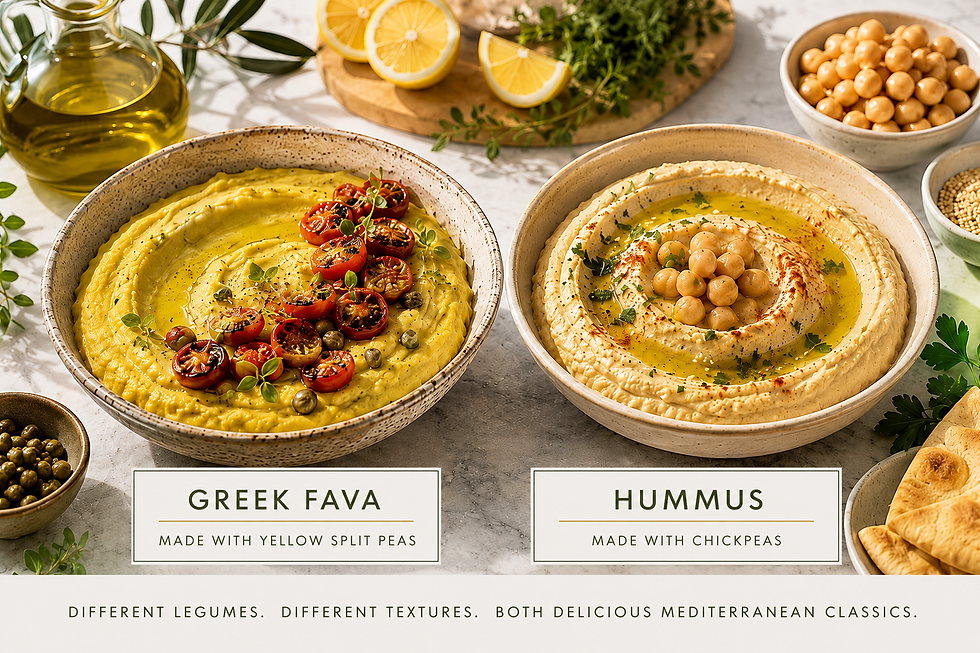
Greek Fava is a traditional Mediterranean dish made from yellow split peas slowly simmered until smooth and creamy.
PJ Kabos recipes are created to highlight the depth, balance, and character of high-phenolic extra virgin olive oil — bringing everyday dishes to life in a simple, natural way.
Interested in learning the difference between Greek Fava and Hummus? Be sure to see our article, Greek Fava vs. Hummus | PJ Kabos Mediterranean Traditions.

Greek Fava — Recipe
Simple ingredients transform into something surprisingly rich, healthy and satisfying — a reminder that some of the world's most enduring foods are also among the most humble.
Finished with lemon and high-phenolic extra virgin olive oil, Fava is equally at home as an appetizer, side dish, or light meal. Its velvety texture and nourishing simplicity have made it a favorite throughout Greece for generations.
Greek Fava — Watch Video
Recipe
Ingredients

500 grams split peas, dry, yellow
1 large onions, sweet, sliced
1 carrot, medium
2 cloves of garlic, or to taste
2 stalks of celery, chopped
2 dry bay leaves
¼ teaspoon oregano, dry
1½ teaspoons sea salt, or to taste
½ teaspoon black pepper, or to taste
3 lemons, juice for mixing in the dip, garnish
½ cup PJ KABOS High-Phenolic Extra Virgin Olive Oil Family Reserve Medium (White Tin)
PJ KABOS High-Phenolic Extra Virgin Olive Oil Family Reserve Phenolic Shot (Gold Bottle), drizzle
oregano, fresh for finishing (optional)
pepper, freshly ground for finishing (optional)
capers, for finishing (optional)
sun-dried tomatoes for serving (optional)
olives, for finishing (optional)
lemon, sliced, to garnish (optional)
Preparation
Prior to cooking
To partially reconstitute, rinse and soak the split peas for several hours, changing the water 2 or 3 times. If you soak for more than 3 hours, or overnight, be sure to refrigerate. Tip: Soaking is optional for yellow split peas, but it may help shorten the cooking time and make them easier to cook, depending on the harvest.
For the vegetables
In a large pot add ¼ cup PJ KABOS High Phenolic, Family Reserve Medium (White Tin). Add the onion, carrot, celery and garlic and oregano; sauté. Set aside in a bowl.
Cooking the split peas
To the same large pot in which the vegetables were sautéed, add the split peas and fill the pot to about an inch from the rim. Place the large pot on a medium-sized burner (Tip: this trick will help to keep the beans from overflowing).
Boil on high. Skim and discard any foam that might form, then to the boiling pot, add the vegetables along with the olive oil in which they were sautéed. Add the bay leaves.
Lightly cover and cook on high (or medium high) until the peas are tender; you may need to add additional boiling water.
After the peas are tender, add the salt and pepper.
Reduce until almost all the water is gone.
To make into dip
Remove the bay leaves.
Cool the peas to an edible temperature.
Add the juice of 1 lemon.
Using a blender, puree the mixture to the desired consistency using the remaining ¼ cup of oil and the juice from the 2nd lemon added slowly as you blend. (Tip: to create a dip that suits your personal taste, additional salt, pepper, lemon, garlic powder and olive oil may be added as you test the dip.)
Arrange the dip on a platter or in a bowl. (Tip: the dip gets thicker as it sits).
Sprinkle lightly with fresh oregano and add thinly-sliced red onions, if desired.
Garnish with capers, sundried or roasted tomatoes, or olives and arrange lemon slices around the dip.
For the pièce de résistance
Serving suggestion
Serve with pita, sourdough or village bread, olives and feta.
It can be enjoyed warm, at room temperature, or lightly chilled, although many Greeks prefer it served at room temperature.
This makes a complete meal for many or it can be an appetizer.
Perfect for anytime of the year.
Kali Orexi—Happy Eating!
Want to Learn More?
Greek Fava and Hummus may look similar, but they're made from different legumes and offer distinct flavors, textures, and culinary traditions.
Contents
PJ Kabos Guide to Olive Oil
Where ancient olive-growing wisdom meets modern science, your guide to choosing, tasting, and enjoying exceptional high-phenolic extra virgin olive oil. We hope it inspires you in your olive-oil journey.
How olive oil quality is defined — and why the difference matters for taste, health, and daily use.
Why extra virgin and high-phenolic olive oils shine in real-life cooking, from sautéing to roasting.
Your simple daily ritual for harnessing the powerful antioxidants in high-phenolic olive oil.
How phenolic compounds support heart, brain, metabolic, joint, and whole-body vitality across the years.
How cholesterol works — and how extra virgin olive oil supports balance and heart health.
A simple guide to the phenolic compounds in olive oil — what phenols and polyphenols are and why they contribute to olive oil’s flavor, stability, and potential health benefits.
VII. What Is a Daily Phenolic Shot of Olive Oil and What Is the EU “Health Claim” Concerning It? | PJ Kabos Guide
How phenolic content varies from oil to oil and from harvest to harvest — and how to choose an olive oil that meets the EU Health Claim.
A clear look at whether extra virgin olive oil contains heavy metals, microbes, or allergens — and how its natural composition, along with laboratory testing, helps us understand what is — and is not — present.
A clear introduction to tasting notes and flavor in extra virgin olive oil — exploring how these natural characteristics arise from the olive, and how bitterness and pungency shape the oil's character and overall tasting experience.
A thoughtful exploration of aroma and appearance in extra virgin olive oil — how scent prepares the palate, how visual cues can mislead, and how these first impressions shape the tasting experience.
Learn how to choose a good olive oil with simple, practical guidance on freshness, origin, packaging, and what truly matters in quality. A simple checklist is included.
What squalene is, why extra virgin olive oil contains it and why this naturally occurring compound has attracted scientific interest.
What happens to extra virgin olive oil at frying temperatures — and what research tells us about stability, reuse and nutrition.
How extra virgin olive oil performs during everyday stovetop cooking — from temperature and stability to flavor and nutrition.
Subscribe and stay tuned — more chapters coming soon.
Please enjoy having a look around our websites and PJ Kabos Amazon Store for more about our many high-phenolic olive oils, recipes, history, etc.
And follow along with us on Instagram for photos concerning olive oil production, our groves in Greece, articles about olive oil, family history and more.


Comments