
Guide 10 | Olive Oil Aroma and Appearance: The First Impression of Olive Oil
Updated: Jul 30
PJ Kabos Guide to Olive Oil
This article is Part 10 of the PJ Kabos Guide to Olive Oil — where ancient olive-growing wisdom meets modern science, your guide to choosing, tasting, and enjoying exceptional extra virgin olive oil. We hope it inspires you in your olive-oil journey.
In Guide 9 | Tasting Notes and Flavor in Olive Oil, we explored what is often considered the most defining expression of an olive oil’s character. But to understand what we taste, it helps to step back for a moment — to what comes before: what we smell, and what we see. These sensory impressions — what we taste, smell, and see— are sometimes referred to as the organoleptic qualities of the oil.
In this article, we therefor turn our attention to the first and often most immediate experience of olive oil — its aroma, and to a lesser extent, its appearance. Before a single drop reaches the palate, the oil has already begun to speak.

Aroma: A first impression
We might think that the first thing we notice about olive oil is its color. But we rarely see the oil until it is poured. Good-quality extra virgin olive oil is protected in painted bottles, tins, or dark glass — shielding it from light and preserving its integrity. Thus experiencing a freshly opened bottle of olive oil begins not with sight, nor taste, but with scent.
What is the first thing most of us do when we open a new bottle? With a quiet sense of anticipation, we bring it gently toward the nose and inhale — long and deep.
Then we smile.
Before we have seen the oil, before it has touched the palate, something has already begun. A fresh, green fragrance rises — subtle, living, unmistakable.
And in that moment, we recognize it — the aroma of a beautifully produced extra virgin olive oil, a fine perfume in a form we will soon taste.
It is in this impression that much of the oil’s character is first revealed — before the palate confirms what the aroma has begun to suggest.
Takeaway:
A Note on What We See — And Its Limits
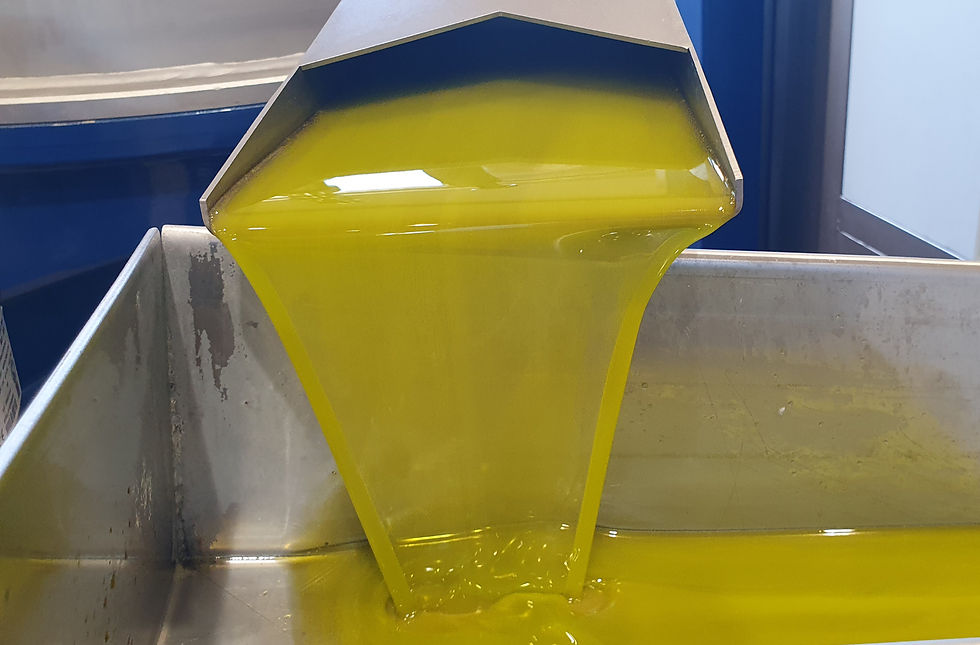
As the oil is poured into the glass, the eye is drawn to its appearance — its color, its clarity, its movement.
We are naturally guided by our sense of sight. Yet where great olive oil is concerned, it is not a reliable indicator of quality. The color of olive oil can vary widely depending on the variety of the olive and the moment of harvest.

For this reason, professional tastings are often conducted in blue-colored glasses, allowing the focus to remain not on what is seen, but on what is perceived.
Takeaway:
What Are Aromas in Olive Oil?
Aromas are the scents we perceive when we smell extra virgin olive oil. Like tasting notes, they are not added. They arise from the natural compounds present in the oil.
You may notice aromas such as:
fresh-cut grass
tomato leaf
green herbs
apple or almond
Together, these — and others — form the fresh, vibrant aroma of a well-made extra virgin olive oil. They are perceptions of familiar fruits and vegetables that help the mind interpret the character of the oil before us, making sense of what is in the glass.
Takeaway:
The Role of Volatile Compounds
Behind these aromas are what are known as volatile compounds.
The aroma of olive oil arises from a complex mixture of natural volatile compounds — including aldehydes, alcohols, and esters — formed within the olive and during the process of extraction. These compounds rise from the oil, carrying its aromas to the nose. They evaporate easily and travel through the air, allowing us to perceive them.
A helpful way to think of this is through something familiar — a cup of coffee or tea. As it sits before you, aromatic compounds are released and rise gently from the surface. You don’t smell the liquid itself — you smell what lifts from it. Olive oil works in a similar way, though more subtly, without the heat that helps release those aromas more readily.
Volatile compounds in olive oil are formed:
in the olive
during crushing
and in the early stages of oil production, where they continue to develop
It is these compounds that give olive oil its aromatic expression. A fresh oil, rich in these compounds, will often present aromas that feel:
green
lively
expressive
Over time, as these compounds diminish, the oil becomes quieter — its aromatic voice softening.
The tasting cups, gently rounded and slightly inward-slanting, help to capture and concentrate these aromas.
Much of the flavor of olive oil comes from its volatile compounds, perceived through aroma — both before tasting and as we taste. It is worth noting however, that these aromatic compounds are distinct from the phenolic compounds that contribute to bitterness and pungency on the palate — though both lend expression to the oil.

Takeaway:
How Aroma Shapes What We Taste
Flavor perception is one of the most complex of human experiences. It draws on many of the senses — especially the sense of smell, which plays a central role in how the brain forms our perception of flavor.
What we smell and what we taste are deeply connected. Although they are closely linked, they are not always identical.
Much of what we describe as flavor begins with aroma.
As we bring the oil to our lips, those same aromatic compounds continue to rise toward the nose, shaping our perception — not only before tasting (orthonasal olfaction), but as we taste (retronasal olfaction). Together, these processes allow us to perceive flavor more fully.
This is why:
an oil that smells vibrant often tastes vibrant
an oil that feels muted in aroma may feel flatter on the palate
Aroma prepares the palate. It gives context to what follows.
Takeaway:
Bringing It Together
When we take a moment to smell olive oil before tasting, something shifts. We begin to notice more.
The green notes feel clearer.
The character more defined.
The experience more complete.
What once passed unnoticed begins to reveal itself.

Frequently Asked Questions
WHAT ARE AROMAS IN OLIVE OIL?
Aromas are the natural scents perceived when smelling extra virgin olive oil, arising from compounds formed within the olive and during production.
ARE AROMAS AND TASTING NOTES THE SAME?
No. Aromas are perceived through smell, while tasting notes are recognized on the palate, though the two are closely connected.
WHY SHOULD I SMELL OLIVE OIL BEFORE TASTING?
Smelling olive oil prepares the palate and enhances the ability to recognize its flavors, both before and during tasting.
WHAT ARE VOLATILE COMPOUNDS IN OLIVE OIL?
Volatile compounds are natural molecules found in many foods and beverages that evaporate easily and carry aroma to the nose. In olive oil, as in the coffee or tea we considered earlier, they allow us to perceive its aromatic character.
DO AROMAS CHANGE OVER TIME?
Yes. As olive oil ages, its volatile compounds diminish, and its aromas become less pronounced.
WHAT DOES “ORGANOLEPTIC” MEAN IN OLIVE OIL?
Organoleptic refers to the sensory qualities of a food — how it is perceived through sight, smell, and taste, as well as texture on the palate. In olive oil, this includes its aroma, appearance, flavor, and mouthfeel.
DO WE TASTE VOLATILE COMPOUNDS IN OLIVE OIL?
We do not taste volatile compounds on the tongue — we perceive them through aroma, both before tasting and as we taste. This is why aroma plays such a central role in how we experience flavor.
WHAT DO WE ACTUALLY TASTE IN OLIVE OIL?
What we taste on the tongue comes primarily from phenolic compounds, which contribute bitterness and the characteristic peppery sensation known as pungency.
IS IT SAFE TO CONSUME EXTRA VIRGIN OLIVE OIL DAILY?
Yes. Extra virgin olive oil has been consumed safely for centuries and is widely regarded as a foundational component of traditional diets, particularly in Mediterranean regions.
Used in everyday cooking, drizzled over foods, or even taken in small amounts on its own, it forms part of a balanced and varied way of eating.
Its long history of use, along with its natural composition, contributes to the confidence with which it is enjoyed daily today all over the world. As with all foods, it is best enjoyed as part of a balanced diet.

Visit our Guide Library to browse all PJ Kabos Guide articles, with titles and brief descriptions to help you find the topics that interest you.
While you're here on The Fat Olive Blog, if you enjoy cooking, please check out our many
PJ Kabos Recipes (e.g., Greek Fava), or explore our Mediterranean Traditions articles (e.g., Ladera Dishes) or step into special moments of our company with PJ Kabos Journal (e.g., Nobu Matsuhisa & PJ Kabos).
You can also have a look around our websites and shop our high-phenolic extra virgin olive oils directly at PJ Kabos.com or OliveOil.com or through PJ Kabos Amazon Store. Follow along with us on Instagram for photos from our groves in Greece, olive oil production, articles, family history and more.
For Those Who Love to Dig Deeper:
Kalua, C.M. et al. (2007). Olive oil volatile compounds, flavour development and quality. Food Chemistry, Science Direct
M. Panagiotopoulou, (2025). Olive Oil Tasting at One&Only Aesthesis | PJ Kabos Journal. The process of smelling and tasting olive oil using blue tasting cups is explored more fully in this article, where we revisit a PJ Kabos tasting experience along the Athenian Riviera.



Comments