
Greek Fava vs. Hummus | PJ Kabos Mediterranean Traditions
Updated: Jul 6
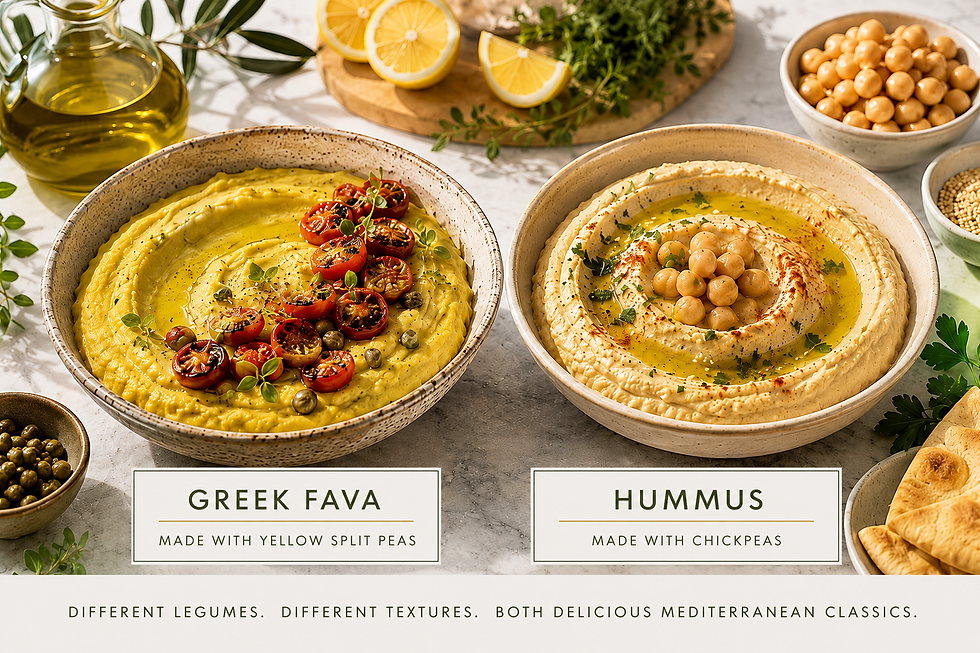
In this article on Mediterranean traditions we are going to take a closer look at Greek Fava and Hummus, two beloved dishes that may appear to be the same but actually are not. So, what's the difference?
PJ Kabos celebrates the foods, ingredients, and culinary heritage of the Mediterranean — where simple ingredients, shared meals, and time-honored traditions remain at the heart of everyday life.
Interested in trying Greek Fava for yourself? Be sure to see our PJ Kabos Greek Split Pea Dip (Fava) |PJ Kabos Recipe.
The Story of Two Legumes
Throughout the Mediterranean, legumes have long played an important role in everyday cooking. Greek Fava and Hummus are among the region's most beloved dishes. They are both creamy, satisfying foods that are often mistaken for one another.
But why is that?
Because both are commonly served as dips or spreads and both are often finished with extra virgin olive oil.
Yet despite their look-alike appearance, Greek Fava and Hummus are made from entirely different legumes and offer distinct flavors, textures, and culinary traditions. Each dish has earned its own special place at the Mediterranean table.
Yellow Split Peas vs. Chickpeas

Greek Fava - Yellow Split Peas
Traditional Greek Fava is most commonly made from yellow split peas (Pisum sativum) or, in the famous PDO (Protected Designation of Origin) version from Santorini, Lathyrus clymenum. (Note: To make things more confusing, despite the common name, Greek Fava is generally not made from broad beans (Vicia faba), which are often called fava beans in English.)
One reason yellow split peas are ideal for Greek Fava is that they naturally soften and break down during cooking, creating the smooth, creamy texture for which the dish is known.
Hummus - Chickpeas
Traditional Hummus is made from chickpeas (Cicer arietinum), also known as garbanzo beans.
Unlike yellow split peas, chickpeas tend to retain their structure during cooking. Their firm texture makes them suitable for a wide variety of dishes, including soups, stews, salads, roasted snacks, and, of course, Hummus.

Taste Profile
Greek Fava and Hummus each offer their own distinctive flavor.
Greek Fava has a mild, earthy flavor with a subtle natural sweetness. Its simplicity allows ingredients such as onions, capers, herbs, lemon, and extra virgin olive oil to shine.
Hummus tends to have a richer, nuttier flavor. Traditional hummus is often made with tahini (sesame paste), which contributes much of its characteristic taste, along with garlic, lemon juice, and olive oil.
While both dishes are comforting, satisfying and delicious, Greek Fava is often described as lighter and more delicate, while Hummus is typically richer and heartier.
Preparation and Cooking
Another important difference lies in how the legumes are prepared.
Yellow split peas naturally soften and break down as they cook, making them relatively quick and easy to prepare. After simmering, they can often be mashed or blended into a smooth puree with little effort.
Chickpeas generally require more preparation. Dried chickpeas must be soaked before cooking and often take longer to become tender. Once cooked, they are blended to create the smooth texture associated with Hummus.

Both dishes are relatively easy to prepare, but many home cooks find yellow split peas to be the simpler legume to work with.
Nutrition
Greek Fava and Hummus are both nutrient-dense foods that fit naturally into a Mediterranean-style diet.
Both provide plant-based protein, dietary fiber, complex carbohydrates, and a variety of vitamins and minerals.
The exact nutritional profile will vary depending on ingredients and preparation. Traditional hummus often contains tahini, which contributes additional healthy fats and minerals. Greek Fava is typically simpler, allowing the nutrients from the yellow split peas and extra virgin olive oil to take center stage.
Rather than viewing one as healthier than the other, many people enjoy both as part of a balanced Mediterranean diet.
Takeaway
While Greek Fava and Hummus may appear similar, they are made from different legumes and offer distinct flavors, textures, and culinary traditions. Both dishes have earned their place at the Mediterranean table, and both pair beautifully with high-quality extra virgin olive oil.

The Most Recent Harvest (2025–26)
Please note: Phenolic levels and profiles vary with each harvest.

Extremely High-Phenolic Organic Extra Virgin Olive Oil
Phenols: 995 mg/kg (HPLC), at production
Hydroxytyrosol (& derivatives): 14+ mg/20 g (far above the EU health claim threshold)
USDA Organic
Kosher
Primary Use: Daily Phenolic Shot
Secondary Use: Finishing, Vinaigrettes
Taste Intensity: Robust +

Very High-Phenolic Organic Extra Virgin Olive Oil
Phenols: 699 mg/kg (HPLC), at production
Hydroxytyrosol (& derivatives): 10+ mg/20 g (well above the EU health claim threshold)
USDA Organic
Kosher
Primary Use: Daily Phenolic Shot, Finishing
Secondary Use: Baking, Cooking
Taste Intensity: Robust

High-Phenolic Organic Extra Virgin Olive Oil
Phenols: 400+ mg/kg (HPLC), at production
Hydroxytyrosol (& derivatives): 7+ mg/20 g (more than meets the EU health claim threshold)
USDA Organic
Kosher
Primary Use: Finishing & Cooking
Secondary Use: Daily Phenolic Shot
Taste Intensity: Medium

High-Phenolic Extra Virgin Olive Oil
Phenols: 400+ mg/kg (HPLC), at production
Hydroxytyrosol (& derivatives): 5+ mg/20 g (meets the EU health claim threshold)
No Pesticides
Kosher
Primary Use: Finishing & Cooking
Secondary Use: Daily Phenolic Shot
Taste Intensity: Medium

Extra Virgin Olive Oil
Phenols 250-300 mg/kg (HPLC), at production
Hydroxytyrosol (& derivatives): 3+ mg/20 g (below the EU health claim threshold; still an excellent EVOO)
No Pesticides
Kosher
Primary Use: Cooking, Baking
Secondary Use: Finishing
Taste Intensity: Delicate
Contents
PJ Kabos Guide to Olive Oil
Where ancient olive-growing wisdom meets modern science, your guide to choosing, tasting, and enjoying exceptional high-phenolic extra virgin olive oil. We hope it inspires you in your olive-oil journey.
How olive oil quality is defined — and why the difference matters for taste, health, and daily use.
Why extra virgin and high-phenolic olive oils shine in real-life cooking, from sautéing to roasting.
Your simple daily ritual for harnessing the powerful antioxidants in high-phenolic olive oil.
How phenolic compounds support heart, brain, metabolic, joint, and whole-body vitality across the years.
How cholesterol works — and how extra virgin olive oil supports balance and heart health.
A simple guide to the phenolic compounds in olive oil — what phenols and polyphenols are and why they contribute to olive oil’s flavor, stability, and potential health benefits.
VII. What Is a Daily Phenolic Shot of Olive Oil and What Is the EU “Health Claim” Concerning It? | PJ Kabos Guide
How phenolic content varies from oil to oil and from harvest to harvest — and how to choose an olive oil that meets the EU Health Claim.
A clear look at whether extra virgin olive oil contains heavy metals, microbes, or allergens — and how its natural composition, along with laboratory testing, helps us understand what is — and is not — present.
A clear introduction to tasting notes and flavor in extra virgin olive oil — exploring how these natural characteristics arise from the olive, and how bitterness and pungency shape the oil's character and overall tasting experience.
A thoughtful exploration of aroma and appearance in extra virgin olive oil — how scent prepares the palate, how visual cues can mislead, and how these first impressions shape the tasting experience.
Learn how to choose a good olive oil with simple, practical guidance on freshness, origin, packaging, and what truly matters in quality. A simple checklist is included.
Subscribe and stay tuned — more chapters coming soon.
Please enjoy having a look around our websites and PJ Kabos Amazon Store for more about our many high-phenolic olive oils, recipes, history, etc.
And follow along with us on Instagram for photos concerning olive oil production, our groves in Greece, articles about olive oil, family history and more.
Please note: This guide is for informational purposes only and should not be considered medical advice. Consult a healthcare professional for personalized guidance regarding your health and medical conditions.
PJ KABOS is a top, on-line seller of High-Phenolic Extra Virgin Olive Oil. It is "For those who want to be good to their bodies."


Comments